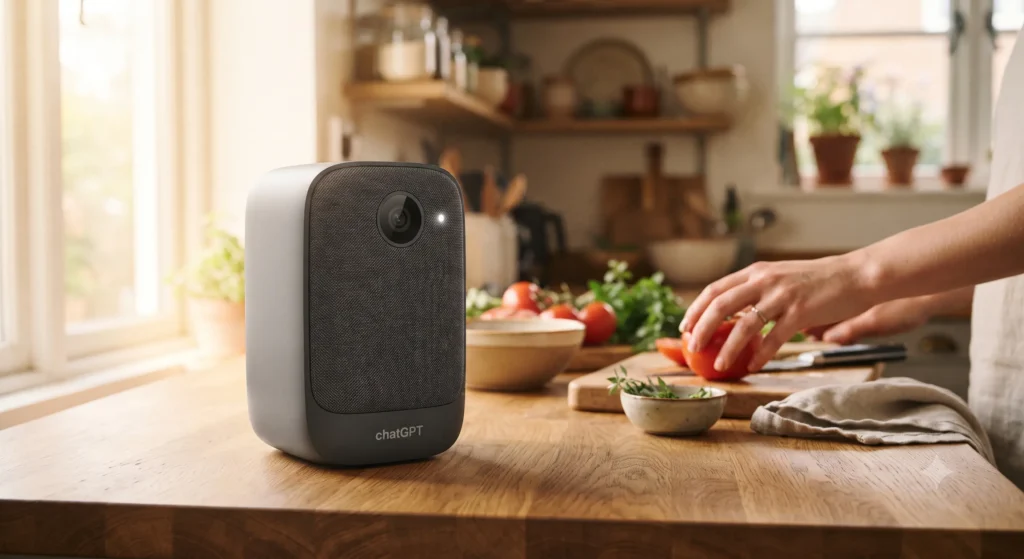

Imagine walking into your kitchen and simply saying, “What should I make with the stuff on the counter?” — and a small, portable speaker actually looks at your ingredients, understands the question, and talks you through a recipe. No screen. No typing. Just a conversation.
That’s the future OpenAI is apparently betting on. According to a new report from Bloomberg, the company behind ChatGPT is working on its first physical device: a portable smart speaker built entirely around voice. Think Amazon Echo, but with a brain powered by ChatGPT and eyes that can see your world.
Let’s break down what we know, why it’s interesting, and why it also raises some eyebrows.
What’s the device actually supposed to be?
Bloomberg describes it as a screenless speaker with a rechargeable battery, a camera, and various sensors. The whole idea is that you’d talk to ChatGPT directly — no apps, no menus, no pulling out your phone. Voice is the main event.
What makes this different from existing smart speakers is the camera and sensor setup. The device wouldn’t just hear you say “turn on the lights.” It could potentially understand what you’re pointing at, recognize objects in the room, or notice when you walk in and adjust its responses based on context.
That’s a big swing. Most smart speakers today are ears-only. OpenAI seems to be betting that giving a voice assistant “eyes” makes it dramatically more useful.
It’s also portable, which matters more than you might think. Most smart speakers are anchored to one outlet in one room. If this thing can follow you from the kitchen to the home office, suddenly ChatGPT isn’t just a kitchen timer — it’s a roaming helper.
And yes, Bloomberg says it would include smart home controls, putting OpenAI directly into competition with Amazon Alexa, Google Assistant, and Apple’s Siri.
Why this makes sense (and why it’s risky)
From OpenAI’s perspective, the logic is pretty clear. They’ve built an incredibly capable AI model that people already talk to on their phones and computers. A dedicated device removes friction. Instead of unlocking your phone, opening an app, and typing a prompt, you just speak.
The camera and sensors could genuinely solve a problem current assistants struggle with: context. When you ask Alexa to “play that song I heard yesterday,” it often has no clue what you mean. A ChatGPT device that can see you humming along to a movie soundtrack might actually figure it out. That’s compelling.
But honestly? Hardware is hard. Really hard. Building software is one thing. Building a physical product that people use daily in messy, noisy homes — and getting the privacy balance right — is a completely different game. A device with a camera designed to observe its surroundings will understandably make people nervous. How does OpenAI handle that camera data? Where does it go? These are questions Bloomberg’s sources didn’t answer.
The awkward legal backdrop
As if launching first-gen hardware wasn’t challenging enough, Apple recently sued OpenAI, alleging the company stole hardware-related secrets. OpenAI has denied the claims, calling them without merit. Still, the timing is uncomfortable. It’s one thing to fight a lawsuit when you’re a software company. It’s another when you’re also trying to manage supply chains, microphones, and battery life for a physical product consumers will judge instantly.
What’s actually confirmed
Not much, to be fair. OpenAI hasn’t announced anything publicly. Bloomberg’s report is based on unnamed sources, and there’s no word on pricing, release date, or even whether the device processes information locally or leans entirely on the cloud.
But the signal is clear: OpenAI wants into your home, and it wants the relationship to feel more natural than any gadget you’ve used before. Whether they can pull it off — and whether we’re ready for a smart speaker that watches us — is the much bigger question.
What do you think — would you put a camera-equipped ChatGPT speaker in your home, or does that cross a line for you?